

Tight healthcare budgets have forced facilities and organizations to focus on cost-avoidance when relating safety in the workplace. It is often difficult to calculate the definitive value of investing in worker safety. However, there are proven benefits in investing in a long-term staff safety program,1 including:
- Reduction in workplace incident risk and exposure to liability
- Creates a more positive working environment
- Can become a positive internal driver of growth
- by reducing staff turnover
- by supporting better engagement
- by improving morale
All of these examples can become an integral part of company culture, bringing far-reaching benefits to the organization.

The International Social Security Administration found that investing in occupational health and safety for staff brought a Return on Prevention ratio of 2.2.2 This means that for every 1 dollar invested in staff safety, organisations gain a return of 2.2 dollars.
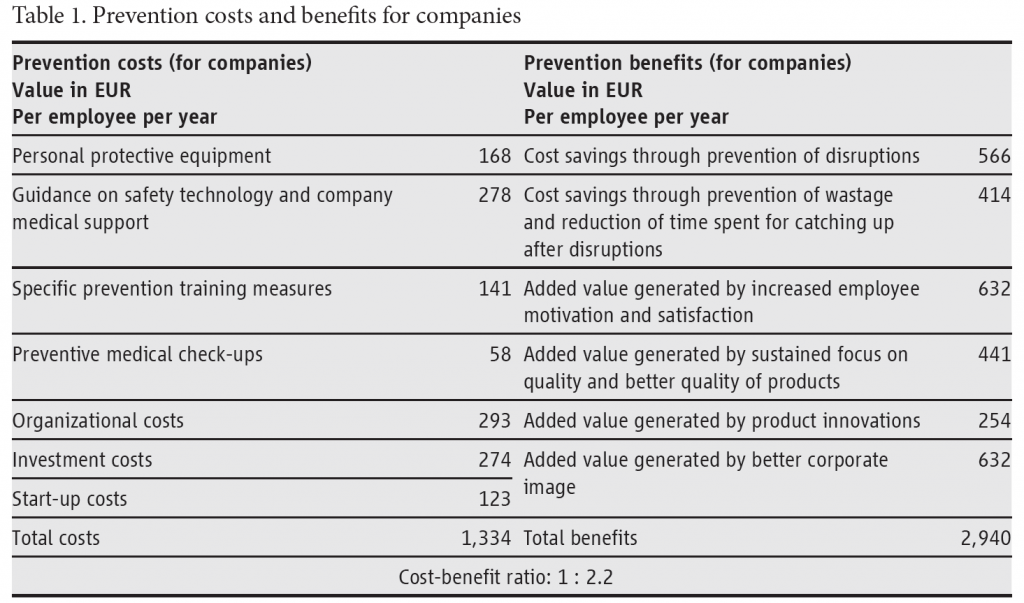
Table 1: Prevention costs and benefits for companies2
With the current COVID-19 pandemic, it has become obvious that when safety equipment is not adequate, healthcare workers’ lives are at risk. And when healthcare workers are unable to protect themselves, patients suffer. It is therefore vital to understand how to implement effective staff safety measures.

Implementing Effective Safety Measures
It all starts with the top management. Administrators should be alert in recognizing potential environmental risks and ensure they are setting the correct tone for what they want to expect from staff. Managers should look to implement the following strategies to make sure that their workers are sufficiently protected against occupational risks and injuries.
- Prioritise a safe and healthy working environment.
An injured worker is an unhappy worker, and unhappy workers costs a ton of money – £15 Billion (18.4 Billion USD) for Great Britain in 2017/2018 to be exact.3 We know that healthy workers stay on the job and can perform their jobs better than injured workers. It also keeps employee replacement and training costs down. In the USA, workers’ compensation losses result in a total annual expense of $2 billion for hospitals.4
Occupational Safety and Health Administration (OSHA) has put together a self-assessment tool, so that hospitals can review their current safety management system and find where improvements can be made. OSHA recommends six core elements in a safety management system which prioritises a safe and healthy working environment:
-
-
-
- Management leadership
- Employee participation
- Hazard identification and assessment
- Hazard prevention and control
- Education and training
- Program evaluation and improvement
-
-
- Hold regular safety checks.
Write a checklist to simplify the process and update as necessary when regulations, procedures, and feedback from workers change. To be successful, it is important that reporting of accidents, even near misses are encouraged. An upward trend of injuries or near misses can indicate that controls are failing and more serious injuries are likely to occur.5 Based on the safety checks, improvements can be made to the organisation’s procedures and policies to reflect the current conditions of the workplace.
- Promote a culture of safety.
When you begin cultivating a culture of safety, workers notice and it becomes part of their mindset. Culture isn’t a tangible resource. Yet there’s a reason why sports coaches around the world stress its importance: it makes a big difference.
- Increase your budget for safety equipment.
Investing in healthcare worker safety increases productivity and reduces costs. Instead of limiting your safety budget, switch your focus by increasing your budget for safety equipment. This can actually reduce the cost of doing business and builds a healthy bottom line. It also means that, at the end of the day, everyone goes home healthy and happy.
These are just a few practical tips on how to invest in healthcare worker safety. To find out more, please email us at hello@copyqlicksmart.kinsta.cloud. We would love to discuss this further with you.
References:
- Sikorski, J., “Connecting worker safety to patient safety: a new imperative for health-care leaders.” Ivey Business Journal, 73(1), 8. 2009
- International Social Security Association, “The return on prevention: Calculating the costs and benefits of investments in occupational safety and health in companies.” Geneva, 2011
- UK Health and Safety Executive, “Costs to Great Britain of workplace injuries and new cases of work-related ill health.” Date Viewed 07 April 2020, http://www.hse.gov.uk/statistics/cost.htm
- AON Risk Solutions, “2012 health care workers compensation barometer.” Date Viewed 07 April 2020, http://www.aon.com/attachments/risk-services/2012-HC-WorkersComp_Barometer_Report_Abridged.pdf
- Doyle, J. (2013). “Occupational health and safety risk in public hospitals.” Victorian Auditor-General’s Report. 2013–14:14
- Laschinger, Heather K. Spence, and Michael P. Leiter. “The impact of nursing work environments on patient safety outcomes: The mediating role of burnout engagement.” JONA: The Journal of Nursing Administration5 (2006): 259-267
Para leer esto en Español, haga clic aquí.